


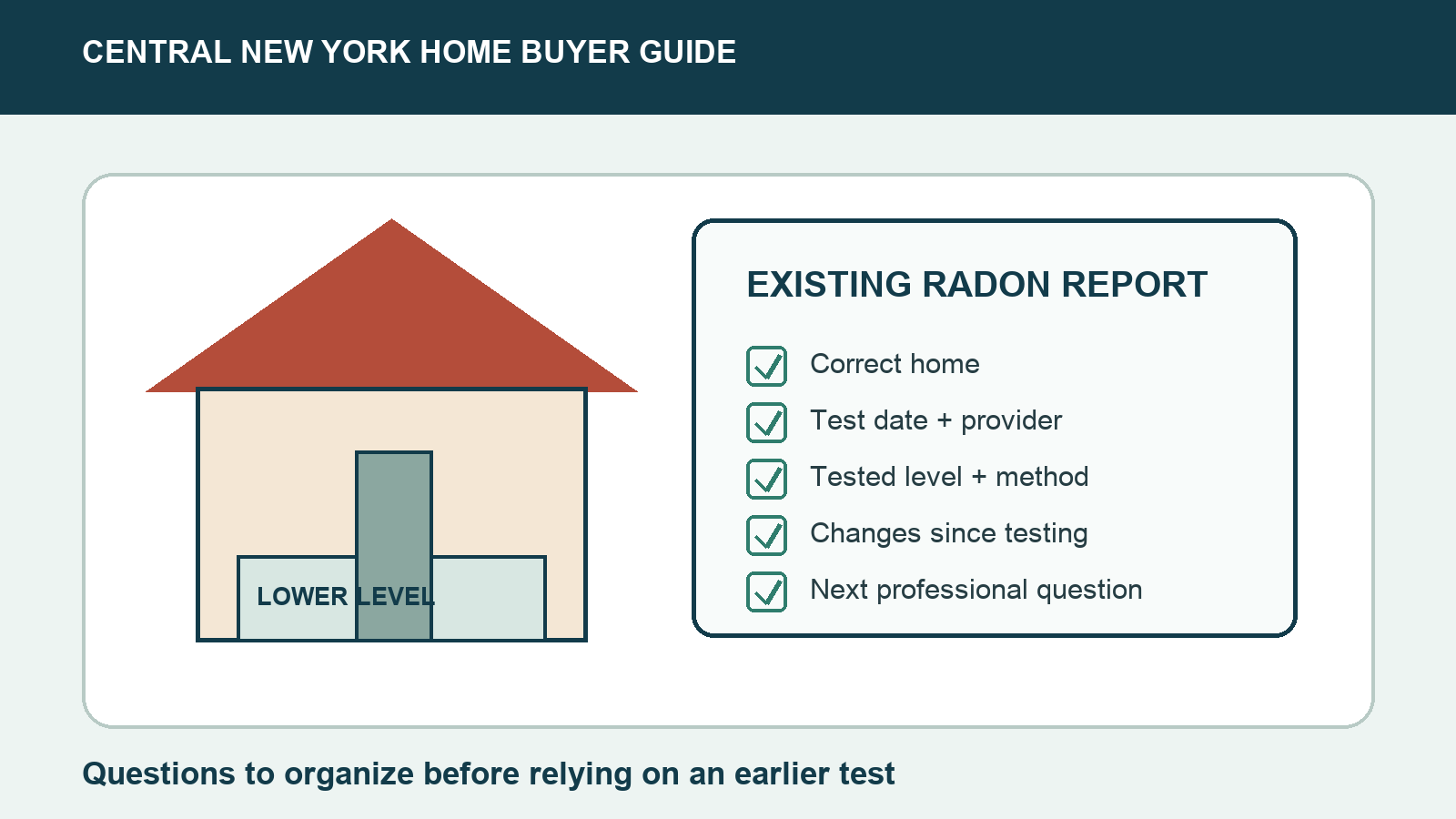
When a seller provides a radon report for a Central New York home, do not judge it by the result on the first page alone. An existing report may be useful, but its relevance depends on the property and level tested, when and how the test was performed, who conducted it, and what changed afterward.
The EPA’s March 2024 revised Home Buyer’s and Seller’s Guide to Radon recommends examining previous test results, the tester, the test location, planned use of lower-level space, and structural or HVAC changes. A qualified radon professional can help determine whether the report answers your questions or whether additional testing is appropriate.
Start with the complete report
Request the complete report rather than a cropped screenshot or a verbal description. Match its property identification to the home you are considering. Note the test dates, provider, testing method and location, and keep any accompanying instructions or qualifications with it.
If something is missing, write down the question rather than filling the gap with an assumption. A statement that a home was tested does not tell you where the test occurred or whether its conditions were appropriate.
Compare the tested space with the space you plan to use
A basement can matter differently to two buyers. One may expect to use it only for storage; another may plan a regularly used office or recreation room. Those are proposed uses, not claims that the space is approved living area.
EPA specifically tells buyers to consider where an earlier test was taken, particularly if they plan to use a lower level. If the earlier test was performed on the first floor but you expect to use the basement regularly, ask a qualified radon professional whether the test location addresses your planned use of the home. Do not use a neighboring home’s result as a substitute; nearby homes can have different indoor radon levels.
Ask what changed after the test
EPA identifies structural alterations and changes to heating, ventilation or air conditioning as questions to consider when evaluating earlier testing. Ask the seller what changed and when, then let the qualified professional assess whether those changes affect the testing decision.
If mitigation equipment is present, request the available installation, service and testing records. Keep installation and service records separate from actual test results. The presence of mitigation equipment does not, by itself, show what a particular test measured; ask a qualified professional what current documentation is appropriate.
Six questions to ask about an existing radon report
- Is this report for the correct home?
Confirm the address and any other property identification shown on the report. - When was the test performed, and who performed it?
Record the test dates and the provider or tester information. - Where and how was the home tested?
Identify the tested level, room or area, testing method, and documented conditions. - What changed after the test?
Ask about subsequent structural alterations and heating, ventilation, or air-conditioning changes. - Does the tested area match how you plan to use the home?
Pay particular attention to a basement or other lower-level space you expect to use regularly. - What should happen next?
Bring missing information and unresolved questions to a qualified radon professional early enough to work within your transaction timeline.
Raise unresolved questions early enough to address them within the applicable deadlines in your purchase contract. Your real estate team can help coordinate document requests; technical testing advice and interpretation belong with a qualified radon professional.
Comparing Central New York homes and trying to keep inspection reports, property documents, and follow-up questions organized? Contact the Procopio Team or call 315-350-0571 to discuss your home search. For radon testing decisions or technical interpretation, consult a qualified radon professional.
Source: U.S. Environmental Protection Agency, Home Buyer’s and Seller’s Guide to Radon, EPA 402/K-24/001, revised March 2024.
By Frank Procopio